
NABOKOV'S TINY MADMEN:
A Triptych

1.
WRITER
The baby was dying.
Did I say the baby was dying? I meant the baby was crying. I could hear her. I would usually have gone to her right away. But I thought she was just crying. What I’m trying to say is, I didn’t know my baby was dying.
My wife was out. I don’t remember where. I was sitting at my computer. I’m a writer and so, you can understand, I was looking for a sentence. I just needed one more sentence. The baby was crying. I was so close to the right words. When I found them inside my head, my fingers put them on the screen, into the file. I hit “save.” The words were stored on a chip. That sentence is still on the hard drive. It must be there. Not one single phrase or syllable is left inside my head.
The baby stopped crying.
My wife came home. She went upstairs. I know my wife screamed. I don’t think she screamed any real words.
Memory is a strange thing. In my nose I can still smell the mock orange blossoms in the vase by my desk that day. My fingers still shake with the same tiny tremor that began with that scream. That day I had a sprig of fresh mint in my tea. I can taste that curious coolness, recall the cold, from tongue, to gullet, to gut, just by thinking back. I don’t drink tea anymore.
The baby was dying. I didn’t know. I swear.
2.
WINGS
There is a little-known tale of a heartless king.
Perhaps I read the words in a childhood picture book. I may have stumbled across the lines in a reference while researching the noble classes. Try as I might, I have been unable to retrace my steps, to relocate the text, to note the provenance, or to cite the source. Yet the story has lurked in my memory like a grain of sand trapped in an oyster. I beg you listen. Then judge the pearl. Report on my madness to those who have sent you.
Listen.
This king’s queen was late with child. The pains came upon her as the royal family vacationed in the highlands.
Physicians ushered the lady into a nearby pavilion and drew about it heavy curtains of purple silk. On the lawn, the remains of an interrupted picnic around them, the young princes and princesses looked to their father, the king, for comfort.
“Your Highness,” said the oldest of the highborn, trembling, “Our mother cries out in great distress. Does she die?”
The king, who had little time for bothersome children, tossed away a half-eaten leg of poultry, wiped his fingers on a linen napkin, and looked down on his son. “Aye, she dies. As she dies each time one of you thieves come to steal some of her life.”
At this the children began to weep.
The cruel king cringed, and he bid them stop. “She does not die. She cries out in joy, awaiting your sibling.”
A princess, catching her breath between sobs, asked, “And where does the baby come from, Your Majesty?”
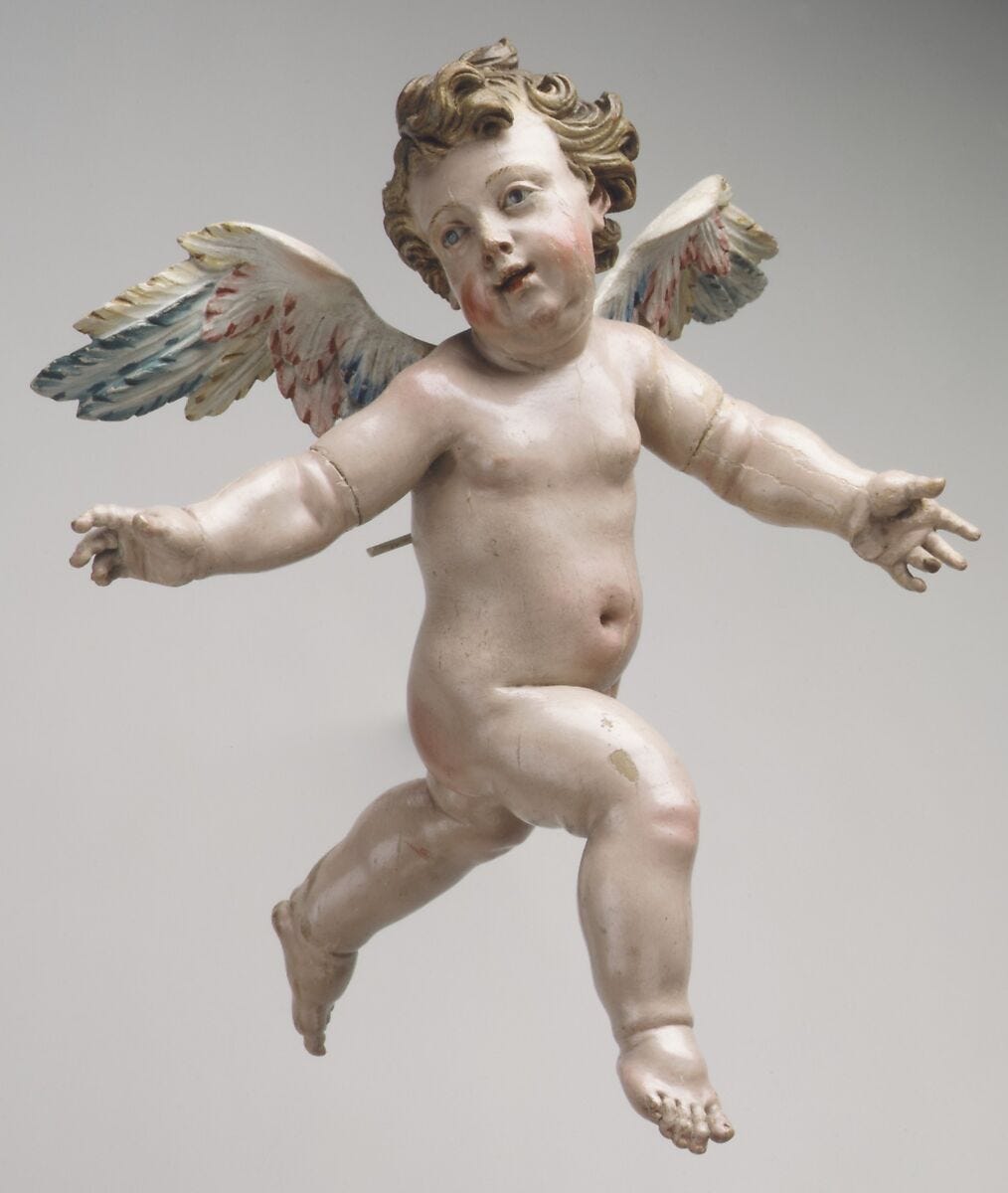
“The babe flies down from heaven on gossamer wings, my love.”
With that the king poured himself another glass of sherry, and the children watched the sky. At last a golden finch flew from the west and landed on the peak of the pavilion. The queen’s cries of pain ceased, replaced by the mewings of a newborn infant.
“As I told you,” said the king.
An announcement came forth, “A son, Your Majesty.” As the drapes closed again, the cries of the baby within grew suddenly louder.
“Why does my brother cry so?” asked the youngest prince.
The king regarded him disdainfully and slowly drew a dagger from his belt. “When the boys arrive from heaven, we must cut off their wings.” The king’s teeth flashed with a smile that was more of an ominous snarl as he pulled back the flap of the birthing tent with his blade and entered.
The cries quieted for a moment then after an awful second’s silence, a fluttering that quickened and then… slowed… and then stopped.
There ends the telling, but not the echo.
I see pity in your eyes. Do not dismiss my unease as childish dread of a fairy tale, nor ascribe my recent turbulent melancholy to the grief of my family’s recent loss.
After my mother’s death, I dispersed her worldly goods to heirs and auctioneers, save one memento hidden in her armoire. Here, I place it on the table. A small box tied with a ribbon and marked with my name and birth date.
Hold it in your hands and tell me. Have you no scars?
Do you not feel the trembling flutter within?
3.
WINDOWS
People get suspicious when you buy a one-way ticket.
A skinny blond girl looked up at me with dull blue eyes and asked, “You won’t be coming back?”
“Not planning to,” I answered. I remember thinking that I should have shaved. My face itched. Does guilt do that or just fresh whiskers?
“One way to Chicago and you’re paying cash?” The girl’s mold green uniform was stained on the left breast – a stray blueberry from an airport muffin vendor. Her corporate logo winked purple as she gestured to a uniformed security man standing in a corner behind the counter.
The man yawned, scratched his federal shoulder patch, and drew me aside to the great relief of a neatly groomed businessman on his way to and back from Cleveland. Impatient to get to Ohio and supervise layoffs at a mechanical pencil factory, he sighed and stepped forward.
My interrogation was, in the final analysis, perfunctory.
“You’re going to Chicago?”
“Yes.”
“Moving there?”
“No.”
“But you’re not coming back?”
“No.”
The Transportation Security Administration officer mulled over the implications. Going but not returning. These were deep questions, rightly considered important for millennia, stretching back from cable news all the way to our furry ancestors. Deep thinkers and fishermen with leaky boats had considered the concept throughout human history. Going but not returning. The guard suppressed a belch. I could smell cayenne pepper in the air.
“Paying cash?”
“Yes.”
“No credit card?”
“I have credit cards.”
“But you’re paying cash?”
“Yes.”
Another non sequitur. Another pause. Finally, perhaps because the man felt some social discomfort, he interjected, “Uh huh.” Silences can be so disorienting, so uncomfortable. He cut to the nub. “Are you a terrorist?”
“No.”
“What are you?” I doubt if he realized how profound the question was.
I answered honestly. “I don’t know.”
The guard’s name was Chad. I noticed his nametag. He didn’t notice my wedding ring. Chad didn’t ask about my wife. I might have told him about our child – about the senselessness. He didn’t ask. Chad was stumped.
“But you’re not a terrorist?”
“No.”
Chad tucked in his shirt. “Dottie, give him his ticket.” Apparently, I was free to go. Apparently, I was free not to return.
On the plane, a woman sat next to me nursing her infant. The top of her breast looked so warm I almost cried.
When I got to Chicago, I went straight to the hotel. It was a very beautiful, tall, art deco building, and I got a room on the forty-third floor overlooking Michigan Avenue. Below me, people came and went in clumps, from sidewalk to street to sidewalk. The day faded.
I thought a lot about the woman on the airplane and her child. I thought a lot about the milk in her breast.
I never even tried to open the window in my room. Funny really, modern buildings just don’t have windows that open anymore. I never did find out if I could fly.
I never went back home.
- the end -